
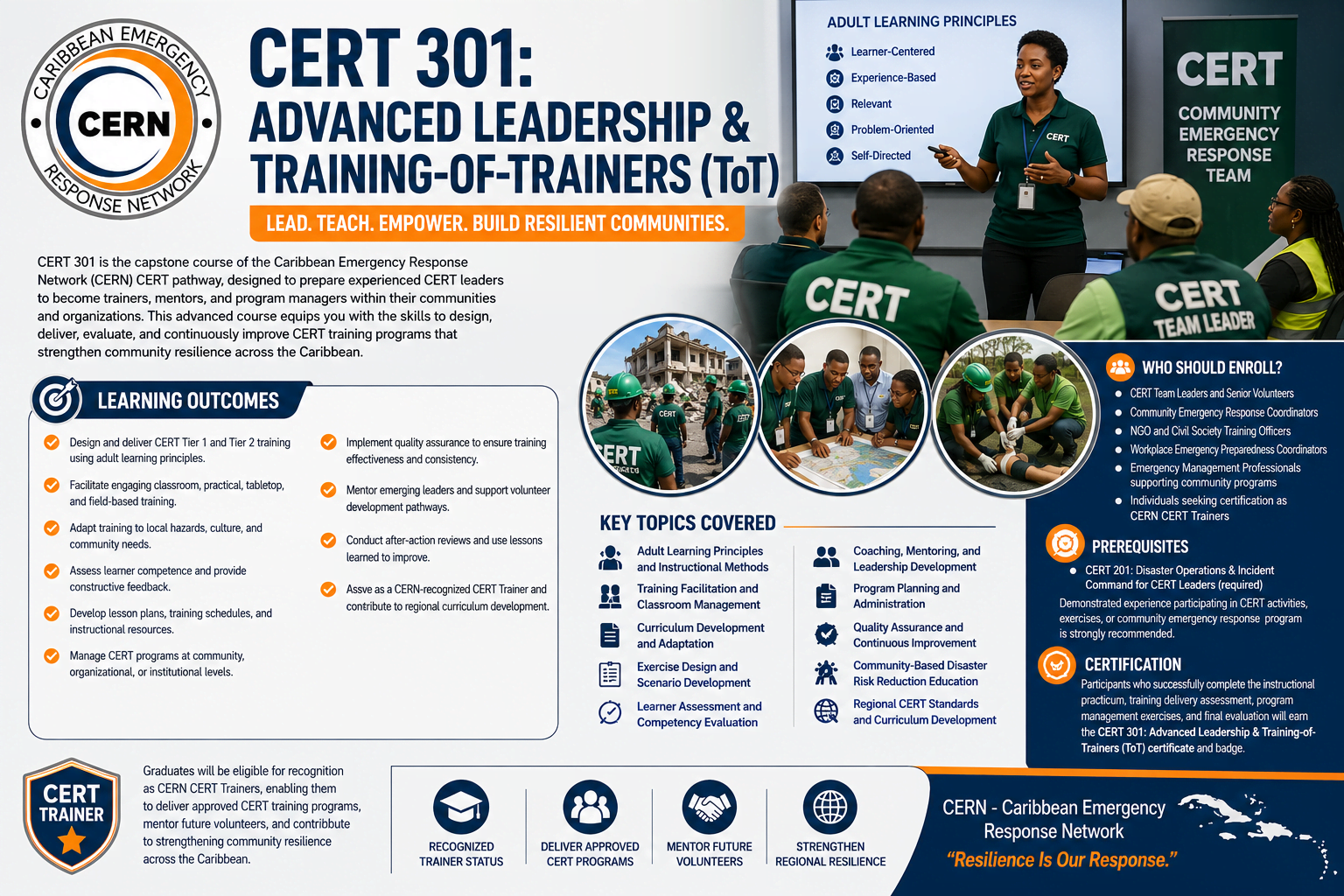
CERT 301: Advanced Leadership & Training-of-Trainers (ToT)
The strength of any Community Emergency Response Team (CERT) program depends on capable leaders who can develop new volunteers, maintain training standards, and build resilient communities. CERT 301 is the capstone course of the Caribbean Emergency Response Network (CERN) CERT pathway, designed to prepare experienced CERT leaders to become trainers, mentors, and program managers within their communities and organizations.
This advanced course equips participants with the knowledge and skills required to plan, deliver, evaluate, and continuously improve CERT training program. Drawing on adult learning principles, instructional design techniques, and Caribbean disaster risk management best practices, learners will develop the ability to facilitate engaging training sessions, assess learner performance, and adapt CERT curricula to local hazards, cultural contexts, and community needs.
Participants will also explore program management, quality assurance, instructor development, and curriculum enhancement processes that support the growth of a sustainable and professional CERT network across the Caribbean. Successful graduates will be prepared to serve as CERN-recognized CERT Trainers and contribute to the ongoing development of regional emergency preparedness and community resilience initiatives.
Learning Outcomes
By the end of this course, participants will be able to:
- Design and deliver CERT Tier 1 and Tier 2 training sessions using adult learning principles and learner-centered instructional techniques.
- Facilitate classroom, practical, tabletop, and field-based training activities that promote learner engagement and competence.
- Adapt training scenarios, exercises, and learning materials to reflect local hazard profiles, cultural considerations, and community vulnerabilities.
- Assess learner competence using structured evaluation methods and provide constructive performance feedback.
- Develop lesson plans, training schedules, and instructional resources that align with CERN standards.
- Manage a CERT program at the community, organizational, or institutional level.
- Implement quality assurance processes to maintain consistency and effectiveness across CERT training activities.
- Mentor emerging CERT leaders and support volunteer development pathways.
- Conduct after-action reviews and use lessons learned to improve training program and operational readiness.
- Serve as a CERN-recognized CERT Trainer and contribute to regional curriculum development and program improvement initiatives.
Key Topics Covered
- Adult Learning Principles and Instructional Methods
- Training Facilitation and Classroom Management
- Curriculum Development and Adaptation
- Exercise Design and Scenario Development
- Learner Assessment and Competency Evaluation
- Coaching, Mentoring, and Leadership Development
- Program Planning and Administration
- Quality Assurance and Continuous Improvement
- Community-Based Disaster Risk Reduction Education
- Regional CERT Standards and Curriculum Development
Who Should Enroll?
This course is designed for:
- CERT Team Leaders and Senior Volunteers
- Community Emergency Response Coordinators
- NGO and Civil Society Training Officers
- Workplace Emergency Preparedness Coordinators
- Emergency Management Professionals supporting community program
- Individuals seeking certification as CERN CERT Trainers
Prerequisites
CERT 201: Disaster Operations & Incident Command for CERT Leaders (required)
Demonstrated experience participating in CERT activities, exercises, or community emergency response program is strongly recommended.
Certification
Participants who successfully complete the instructional practicum, training delivery assessment, program management exercises, and final evaluation will earn the CERT 301: Advanced Leadership & Training-of-Trainers (ToT) certificate and badge.
Graduates will be eligible for recognition as CERN CERT Trainers, enabling them to deliver approved CERT training programs, mentor future volunteers, and contribute to strengthening community resilience across the Caribbean.
CERN - Caribbean Emergency Response Network
"Resilience Is Our Response."
- Teacher: Admin User
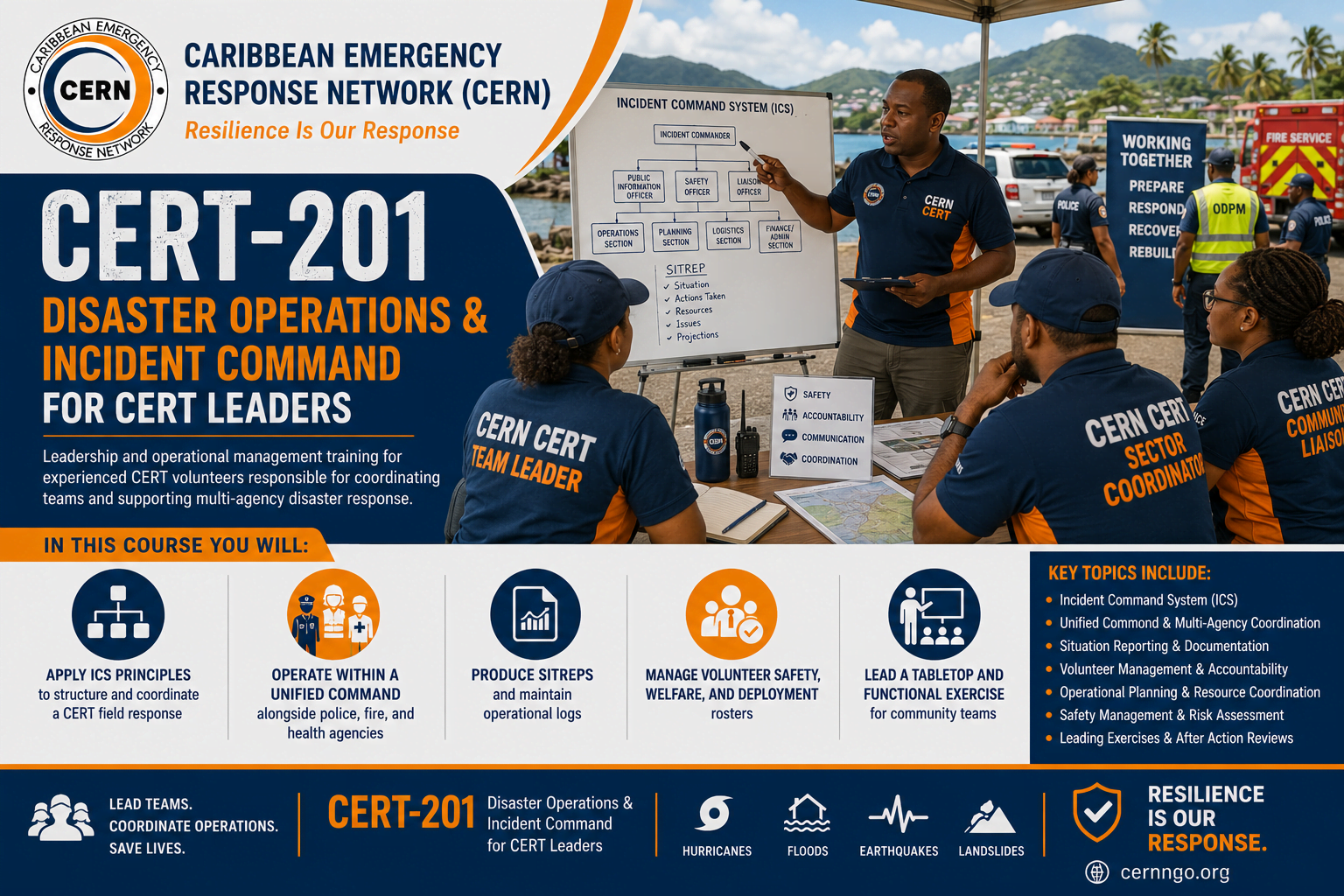
CERT 201: Disaster Operations & Incident Command for CERT Leaders
Effective disaster response requires more than technical skills it requires leadership, coordination, and the ability to manage operations in dynamic and often challenging environments. CERT 201 prepares experienced Community Emergency Response Team (CERT) volunteers to transition into leadership roles where they can coordinate teams, manage resources, and support multi-agency disaster operations.
Designed specifically for Caribbean communities and small island developing states (SIDS), this course introduces participants to the principles of the Incident Command System (ICS) and its application within local emergency management structures. Learners will explore how CERT leaders integrate with national disaster offices, emergency operations centers (EOCs), and responding agencies such as police, fire, health services, and humanitarian organizations.
Through practical exercises, simulations, and leadership scenarios, participants will develop the skills necessary to organize field operations, maintain situational awareness, manage volunteers safely, and support decision-making during emergencies. The course emphasizes communication, accountability, resource management, and operational coordination within a unified command environment.
Learning Outcomes
By the end of this course, participants will be able to:
- Apply Incident Command System (ICS) principles to structure and coordinate CERT disaster response operations.
- Operate effectively within a unified command structure alongside police, fire, health, and disaster management agencies.
- Establish and manage basic command, operations, planning, logistics, and communications functions during an incident.
- Prepare and submit Situation Reports (SitReps), operational updates, and incident documentation.
- Maintain operational logs and records to support accountability and post-incident review.
- Manage volunteer safety, welfare, accountability, and deployment rosters during extended operations.
- Coordinate information flow between field teams, Emergency Operations Centers (EOCs), and community stakeholders.
- Conduct risk assessments and make informed operational decisions in rapidly changing environments.
- Lead and facilitate tabletop exercises and functional exercises for community response teams.
- Demonstrate leadership, teamwork, and ethical decision-making during disaster operations.
Key Topics Covered
- Introduction to the Incident Command System (ICS)
- CERT Leadership Roles and Responsibilities
- Unified Command and Multi-Agency Coordination
- Emergency Operations Centre (EOC) Integration
- Situation Reporting (SitReps) and Operational Documentation
- Volunteer Management and Personnel Accountability
- Operational Planning and Resource Coordination
- Safety Management and Risk Assessment
- Community Liaison and Public Information Support
- Exercise Design, Facilitation, and Evaluation
Who Should Enroll?
This course is designed for:
- Experienced CERT volunteers
- CERT Team Leaders and Deputy Team Leaders
- Community Sector Coordinators
- NGO and faith-based emergency response leaders
- Community resilience officers
- Workplace emergency response supervisors
- Individuals preparing for leadership roles within community emergency response programs
Prerequisites
CERT 101: Disaster Preparedness & Community Emergency Response Fundamentals (required)
CERT 102: Basic Life Support & First Aid for Disaster Settings (recommended)
Certification
Participants who successfully complete the course assessments, leadership exercises, and incident management scenarios will earn the CERT 201: Disaster Operations & Incident Command for CERT Leaders certificate and badge.
This course serves as the leadership bridge between basic CERT training and advanced emergency management, preparing volunteers to coordinate safe, organized, and effective disaster response operations throughout the Caribbean.
CERN: Caribbean Emergency Response Network
"Resilience Is Our Response."
- Teacher: Admin User
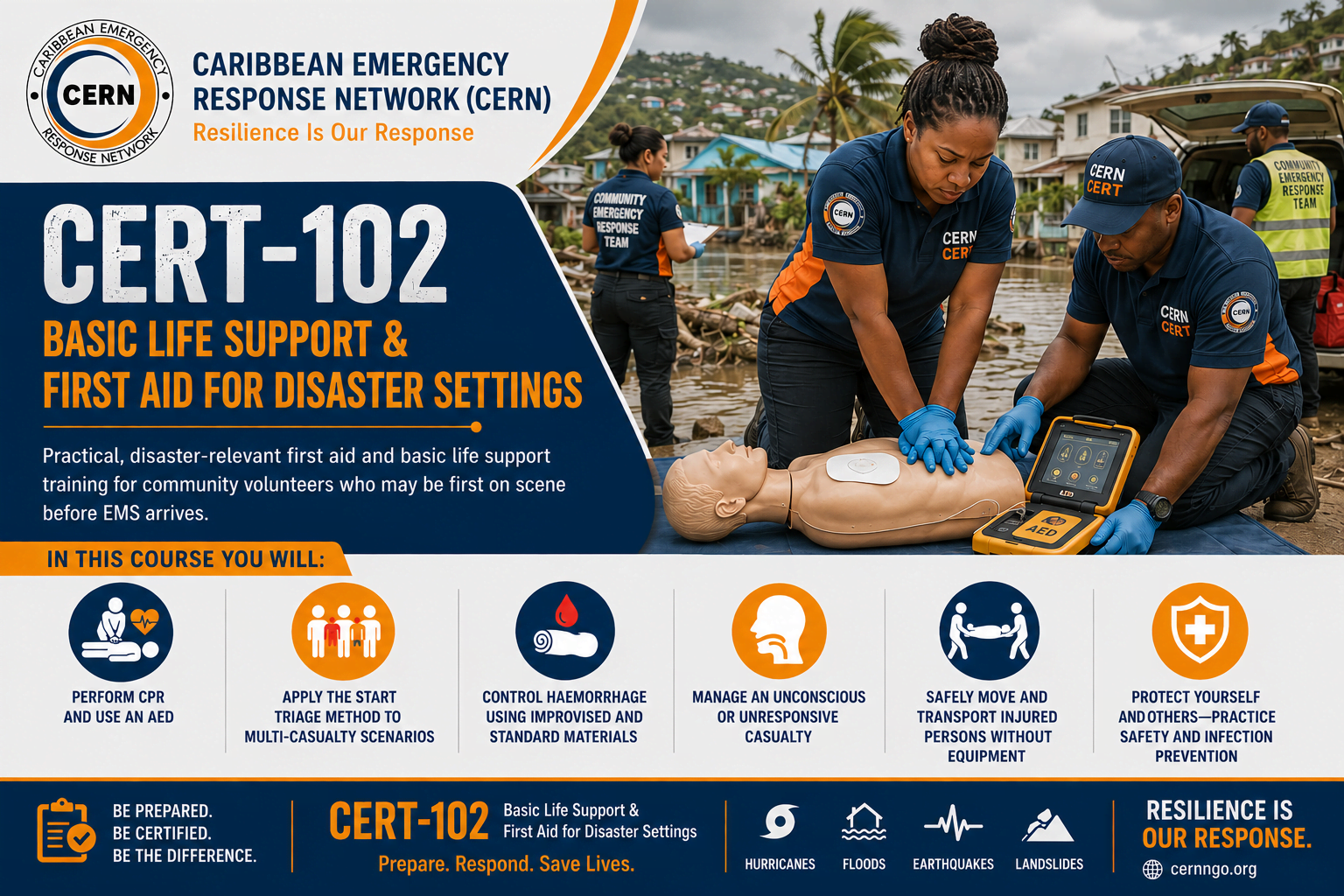
When disasters strike, community members are often the first to provide assistance before professional responders arrive. CERT-102 equips Community Emergency Response Team (CERT) volunteers with the essential skills needed to deliver safe, effective, and life-saving care during emergencies and disasters.
This practical, disaster-focused course introduces participants to basic life support (BLS), emergency first aid, and casualty management in resource-limited environments. Learners will develop the confidence to assess injured persons, prioritize care using mass casualty triage principles, and provide immediate interventions that can preserve life and prevent further harm.
Through realistic disaster scenarios and hands-on exercises, participants will learn how to perform CPR, operate an Automated External Defibrillator (AED), control severe bleeding, manage unconscious casualties, and safely move injured persons when specialized equipment is unavailable. Special emphasis is placed on community response during hurricanes, floods, earthquakes, structural collapses, and other Caribbean hazards where professional medical assistance may be delayed.
Learning Outcomes
By the end of this course, participants will be able to:
- Perform high-quality Cardiopulmonary Resuscitation (CPR) on adults and children.
- Safely operate an Automated External Defibrillator (AED) during cardiac emergencies.
- Apply the START triage method to prioritize casualties during multi-casualty incidents.
- Control haemorrhage using both standard and improvised bleeding control techniques.
- Assess and manage unconscious or unresponsive casualties, including airway management and recovery positioning.
- Safely move and transport injured persons using improvised methods and team-based techniques when equipment is unavailable.
- Demonstrate personal safety and infection prevention practices while providing emergency care.
- Support CERT operations by providing immediate lifesaving interventions until Emergency Medical Services (EMS) or advanced medical teams arrive.
Who Should Enrol?
This course is designed for:
- CERT members and volunteers
- Community leaders and neighborhood response teams
- NGO and faith-based organization volunteers
- Workplace emergency response personnel
- Teachers, coaches, and youth leaders
- Any community member seeking disaster-response first aid skills
Prerequisites
CERT 101: Disaster Preparedness & Community Emergency Response Fundamentals (recommended but not mandatory)
Certification
Participants who successfully complete the course assessments and practical skills evaluations will earn the CERT 102: Basic Life Support & First Aid for Disaster Settings certificate and badge within the Caribbean Emergency Response Network (CERN) CERT training pathway.
- Teacher: Admin User
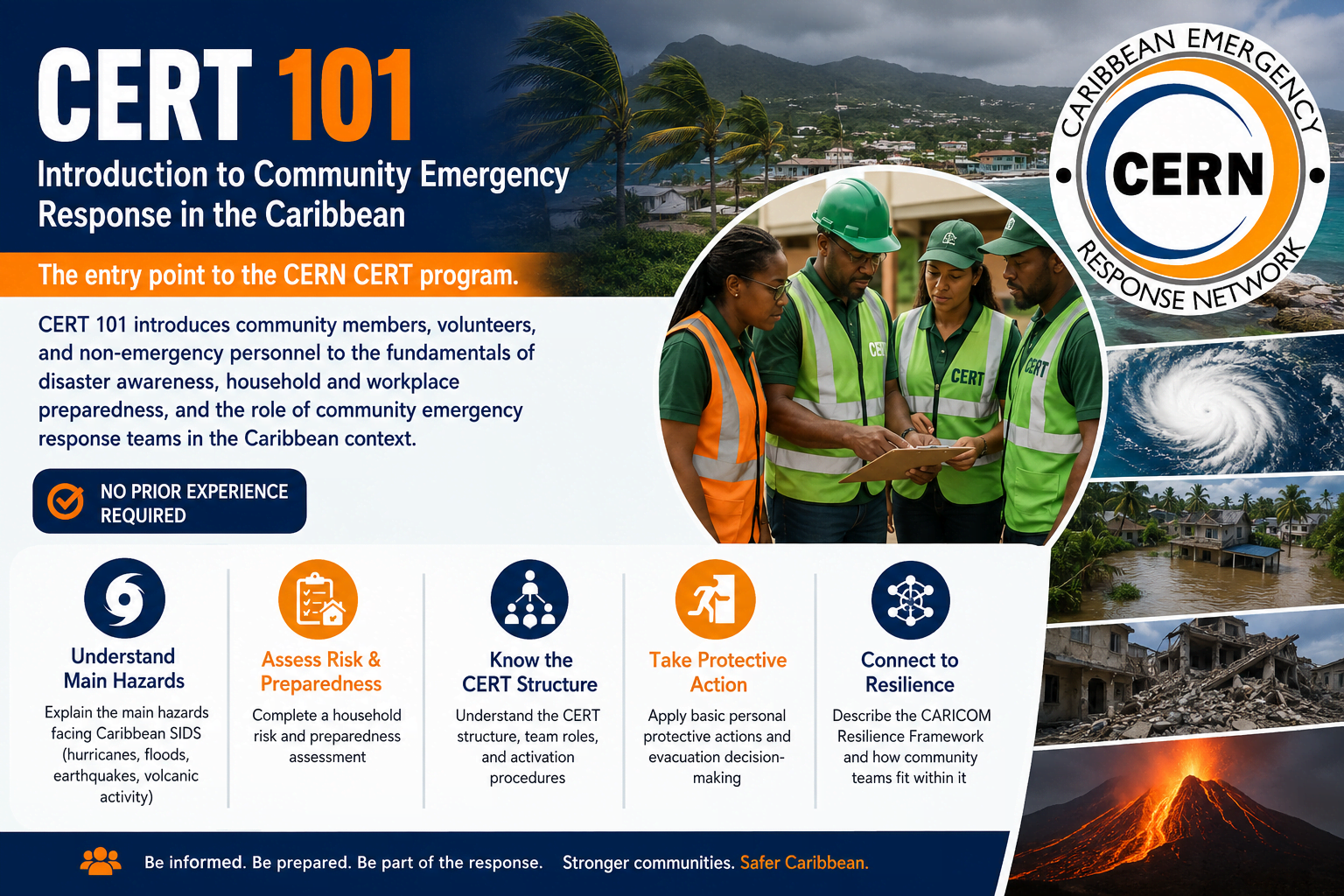
The entry point to the CERN CERT program. CERT 101 course introduces community members, volunteers, and non-emergency personnel to the fundamentals of disaster awareness, household and workplace preparedness, and the role of community emergency response teams in the Caribbean context. No prior experience required.
- Explain the main hazards facing Caribbean SIDS (hurricanes, floods, earthquakes, volcanic activity)
- Complete a household risk and preparedness assessment
- Understand the CERT structure, team roles, and activation procedures
- Apply basic personal protective actions and evacuation decision-making
- Describe the CARICOM Resilience Framework and how community teams fit within it
- Teacher: Admin User